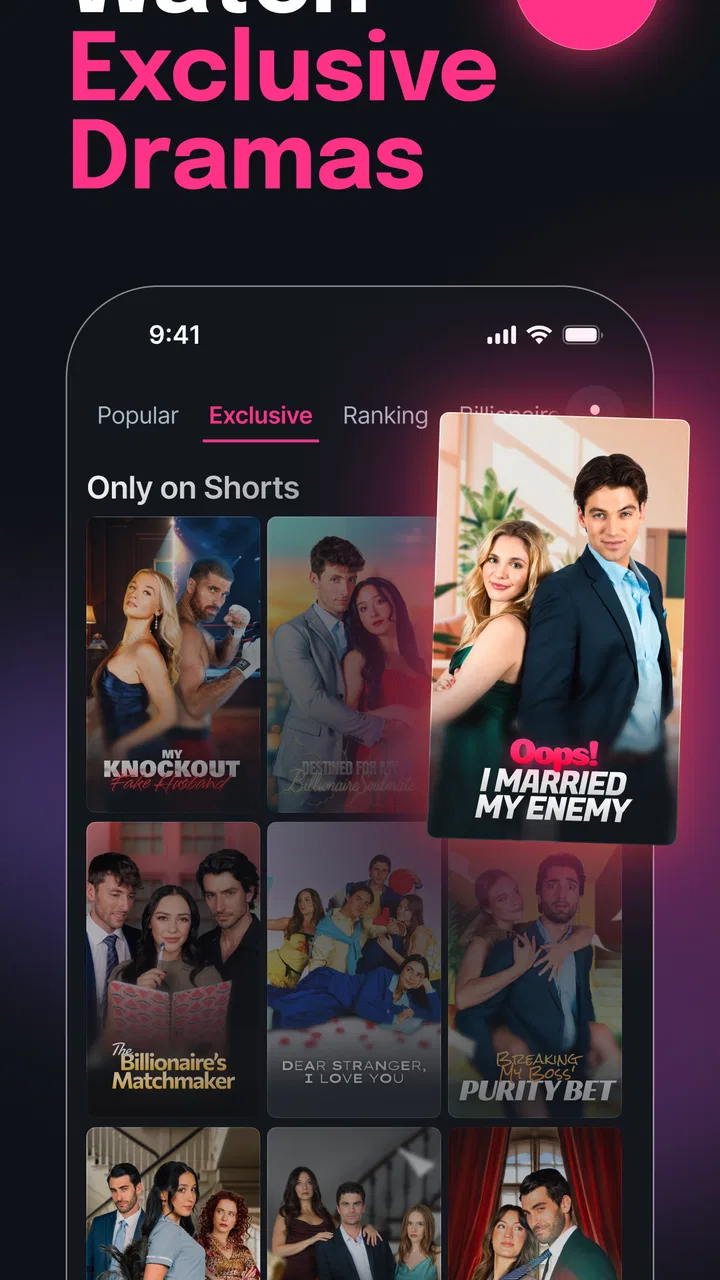
Shorts - Reel TV Short Drama
- 4.6
- Rating
- 100.00K
- Installs
- Free
- Price

 Analysis by App-foxy
I tried Shorts - Reel TV Short Drama as a quick entertainment app rather than treating it like a replacement for a full streaming service. That distinction matters. Its focus is short dramas and bite-sized movies, so the appeal is easy to understand: open the app when I have a few spare minutes, choose something compact, and get into a story without committing to a long film or a full television episode.
The app comes from AndroidLuni and sits in the entertainment category. It is free to install, although individual in-app purchases range from $1.99 to $199.99. That combination makes it approachable at first, but it also means I would not hand a shared device to a child and assume that “free” describes the entire experience. The content is marked Mature 17+, which is the first detail I would discuss in any household using the same phone or tablet.
My overall impression is positive for viewers who enjoy fast, dramatic storytelling and like browsing in short sessions. I would be more cautious with anyone looking for a calm family video app, a large traditional catalog, or a clearly separated profile system. The strongest way to use it is with sensible boundaries: one person chooses what to watch, adults understand the age rating, and nobody treats the app’s free entry point as an unlimited promise.
You May Also Like

 Blood Strike: 2.5 Anniversary
Blood Strike’s Loadouts Turn Every Drop Into a Tactical Gamble
A close look at Blood Strike’s custom loadouts: how fast access to signature weapons reshapes its battle royale rhythm, rewards preparation, and narrows the gap between fights.

 Pandora - Music & Podcasts
Pandora’s Music Is Easy to Start, but Harder to Recover
Pandora’s strength is its low-effort path from a seed to a station. Its weak spot is how much confidence it asks you to place in connection, setup, and quiet recovery.

 8 Ball Pool
 Is Built on Rivalries, Rematches, and Routine
A close look at the rivalries, rematches, shared routines, and unanswered safety questions that turn a quick pool match into a persistent mobile community.

 Samsung Music
’s Quiet Strength Is Playing What You Already Own
Its reach comes less from spectacle than from dependable access to a personal library. That simplicity is both the app’s strongest retention engine and its ceiling.

 AccuWeather: Weather Radar
AccuWeather Review: A Quick, Clear Forecast for Everyday Decisions
For everyday plans, the best forecast is the one you can understand quickly. AccuWeather makes rain timing, radar, and local conditions easy to act on, with a few trade-offs.

 Hill Climb Racing
Why Hill Climb Racing Still Turns Crashes Into One More Run
A tiny car, a bumpy hill and one more upgrade: Hill Climb Racing keeps resurfacing because its simple chaos makes every near-miss feel personal.
More From Our News Desk
View All News


How it fits into a shared household
When I think about Shorts in a shared household, the main question is less about who gets the phone and more about how to keep personal viewing, age boundaries, and spending expectations clear. I’d agree on those basics before anyone browses, then decide whether the app belongs on a shared screen or an adult’s device. That practical choice leads naturally to what a first-time user should consider before installing it.
A realistic evening with one phone
A typical use case is a shared device in the living room. One person finishes checking messages, another wants something to watch while dinner is being prepared, and there is no interest in starting a two-hour movie. Shorts - Reel TV Short Drama suits that moment better than a conventional streaming platform because its basic idea is built around smaller viewing commitments.
I can imagine using it during a short break, while waiting for an appointment, or at the end of the day when I want a little plot without having to remember where a long episode stopped. The short format also makes it easier for different people in a household to take turns. One viewer can watch for a while, then pass the device along without turning the evening into a major schedule.
That convenience has a trade-off. Short drama apps are designed to keep the next piece of a story close at hand, and that can make “just one more” tempting. On a shared device, this creates a simple coordination problem: the person who starts a story may expect to continue it, while someone else may want to browse or watch a different title. I recommend agreeing on whose turn it is before opening the app, especially when several people use the same Android phone or tablet.
Why the short format feels different
The app’s format is not merely a smaller version of ordinary television. A full streaming service is usually better when I want polished long-form storytelling, a familiar movie night, or a catalog that the household can browse together for a long time. This app is more useful when attention is fragmented and the viewer wants a quick emotional hook.
That makes it a good companion to, rather than a direct replacement for, services built around full films and standard episodes. I would choose Shorts for a spare moment and a conventional service for a planned family viewing session. If everyone wants to watch the same story from beginning to end without interruptions in the routine, the longer-form alternative is likely the less frustrating choice.
There is also a practical benefit for people who struggle to decide what to watch. A short title feels less risky than starting a long series. I can sample the style and move on if it does not work for me. The downside is that a viewer who prefers patient character development may find the compressed approach too hurried. The app’s central strength is also its main artistic limitation.
Setting boundaries before handing over the device
Because the content rating is Mature 17+, I would not use this app as an unsupervised entertainment option for younger members of a household. That advice is not about assuming every title has the same tone; it is about respecting the rating shown for the app as a whole. A shared tablet should be treated as an adult-oriented entertainment space unless the adult responsible has checked what is being opened.
I would also separate viewing permission from purchasing permission. The app costs nothing to install, but its in-app purchase range reaches from $1.99 to $199.99 per item. On a device used by several people, the person watching should not automatically be the person authorized to spend money. Before anyone else uses the app, I would make clear who can approve purchases and who cannot.
This is particularly important when a family shares one store account or one payment method. I would avoid leaving a device unlocked with payment approval already available, and I would ask younger users not to tap purchase prompts simply to see what happens. These are ordinary household precautions, but they matter more here because the app combines free access with optional paid items.
A useful routine is to let one adult install and inspect the app first, then explain the household rule in plain language: viewing may be allowed for the appropriate adult, while spending requires permission every time. That approach is more reliable than assuming that a shared device automatically keeps everyone’s activity or purchases separate.
Keeping viewing coordinated
Shared use works best when each person has a clear handoff. If I stop halfway through a short drama, I would tell the next viewer that I have left a story unfinished rather than assuming the app will make the boundary obvious. This small habit prevents accidental spoilers and avoids the familiar argument over whether someone has skipped ahead.
I would also avoid treating the app as a communal queue unless the household agrees on one. A parent, partner, or roommate may open it expecting to continue a title, while another person may immediately choose something new. Since the experience is centered on browsing short dramas, the temptation to switch quickly is stronger than it would be with a disc, a downloaded film, or a carefully planned television schedule.
For a couple sharing a device, a simple verbal handoff is probably enough. For a larger household, I would keep the app associated with an adult’s viewing time and avoid letting every person browse freely. That is not because the app is difficult to operate; it is because the combination of mature content, personal preferences, and paid options makes casual coordination less comfortable.
Another practical tip is to watch with headphones when the device is being used in a shared room. Short dramas can move quickly between emotional or tense scenes, and private audio reduces the chance that another person hears something they did not choose to watch. It also makes the app easier to use during a break without turning a personal viewing session into background entertainment for everyone nearby.
Account expectations on a common device
I would not assume that a single installation creates separate household spaces. If several people use the same app session, they should understand that browsing and viewing choices may be visible to the next person who opens it. I would keep personal expectations modest and use an individual device when privacy is important.
This matters for adults sharing a tablet as much as it does for parents and children. One person may enjoy romantic drama, another may prefer a different tone, and neither may want the other to make assumptions based on a title left on screen. The safest approach is to treat a shared device as a shared viewing surface, not as a private account environment.
If separate phones are available, I would give each adult their own installation and avoid mixing sessions. If only one device is available, I would close the app after viewing and return the device to its owner rather than leaving a title paused. That is a small privacy habit, but it also makes the next handoff cleaner.
The app runs on Android 8.0 or later, so compatibility is reasonably broad for older supported Android devices. Still, I would check the actual phone or tablet before planning a household setup, particularly if the shared device has been kept for many years. Compatibility is not the same as comfort: a larger screen and dependable battery are much more pleasant for drama viewing than an old phone used while charging.
Age, trust, and mature viewing
The Mature 17+ label should be treated as a household decision point, not as a minor note on the download screen. If a teenager is close to that age, I would still want an adult to decide whether the app fits the family’s rules. The rating gives useful context, but it does not replace a conversation about what the viewer is allowed to access.
I would be especially careful with a device that children use for school, games, and entertainment. Installing an adult-rated drama app alongside child-oriented apps can blur expectations. A younger user may see the icon and assume it is acceptable simply because it is installed. In that situation, I would keep the app on an adult’s personal device rather than making it part of the shared tablet’s normal home screen.
Trust also includes spending. A mature viewer may be old enough to watch but still not be authorized to buy anything. Those are separate permissions, and I think households should state that clearly. The free installation can create a relaxed first impression, while the listed purchase range means financial boundaries still belong in the setup conversation.
For adults living together, the issue is less about parental supervision and more about mutual respect. One person should not use another person’s account or payment method casually. If the app is installed on a partner’s phone, I would ask before making any purchase and avoid assuming that a free title or free access means every part of the experience is included.
What the current release tells me
The current version is 2.4.0, and the app was released on Feb 6, 2025. Those details place it in a relatively recent stage of its life, so I would keep normal expectations about ongoing refinement. In practical terms, I would update it when an update is offered, especially on a shared device where several people depend on the same installation.
Its public reception is encouraging: the app holds a 4.6 average from around 20K ratings, with over 500 reviews and more than 100K installs. I read those figures as evidence that the concept has found an audience, not as a guarantee that every household will enjoy it. Short-form drama is a specific taste, and a strong overall score cannot resolve the personal question of whether compressed storytelling feels satisfying to you.
I also would not confuse popularity with suitability for children or with a promise of premium long-form production. The rating, payment structure, and short format are more relevant to a family decision than the install count. For me, the numbers support trying the app, while the household rules determine whether it belongs on a shared screen.
Where it beats familiar alternatives
Compared with a standard streaming app, Shorts has a clear advantage when I have limited time. I do not need to reserve an entire evening or persuade everyone in the room to commit to the same long program. That makes it a handy option for adults who want a quick story during a commute break, a lunch pause, or the quiet minutes before bed.
Compared with social video feeds, the drama focus can feel more intentional. Instead of endlessly moving between unrelated clips, I can approach the app with the expectation of following a narrative. That said, anyone who wants broad entertainment, news, educational videos, or children’s programming will find a general video platform more versatile.
Compared with free television services, the app’s appeal is its compact drama format rather than a traditional channel schedule. Viewers who enjoy choosing a specific story should appreciate that difference. Viewers who prefer passive viewing, live programming, or a familiar library of major films should look elsewhere.
The purchase model is where I would compare carefully. A free download is convenient for trying the format, but the listed price range means I would not make it my default recommendation for someone seeking entertainment with a strictly fixed household budget. A service with a predictable subscription or a clearly defined free catalog may be easier to manage financially, even if it offers less specialized short drama.
Small habits that improve the experience
My first tip is to decide whether the session is personal or shared before browsing. Personal viewing gives me freedom to follow a story at my own pace. Shared viewing requires a quick agreement about age suitability, whose turn it is, and whether purchases are off-limits. Making that decision early prevents most of the friction I associate with common-device entertainment.
My second tip is to use the short format deliberately. I would not open the app when I am already late or distracted and then blame the stories for failing to hold my attention. It works better as a controlled break: choose one compact viewing session, finish or pause it consciously, and close the app when the break ends.
My third tip is to keep expectations aligned with the genre. If I want subtle pacing, extended world-building, or a carefully structured feature film, I choose a conventional streaming service. If I want immediate drama in a small time window, this app makes more sense. Knowing that difference saves money and disappointment.
Finally, I would keep payment decisions with the account owner and treat the Mature 17+ rating as a real boundary. Those two rules are more valuable than any browsing trick because they protect both the household budget and the people sharing the device.
My household verdict
I recommend Shorts - Reel TV Short Drama to adults who enjoy dramatic mini-series and want entertainment that fits around a busy day. AndroidLuni has positioned it for viewers who prefer quick stories over long commitments, and the free installation makes it easy to test that format. The positive rating and growing install base suggest that many people find the idea appealing.
I would skip it for a family seeking a child-friendly shared video app, a private multi-user setup, or a predictable all-inclusive viewing service. The Mature 17+ label requires adult judgment, and the in-app purchase range means the household should establish spending rules before anyone else uses the device.
For my own use, the best arrangement is simple: an adult installs it on a suitable Android device, checks the viewing context, keeps purchase approval separate from casual browsing, and tells other household members when a story is in progress. Used that way, it is a convenient source of compact drama rather than a source of confusion. Its real value is not replacing every streaming option; it is making a few spare minutes feel like a complete viewing session.
FAQs for Shorts - Reel TV Short Drama
01What is Shorts - Reel TV Short Drama, and what type of content does it offer?
Shorts - Reel TV Short Drama is a mobile entertainment app focused on brief, vertically formatted drama episodes designed for quick viewing. Its catalog generally includes romance, suspense, family conflict, and other serialized stories divided into small chapters. The format is convenient for watching during short breaks, although the availability of specific shows and episodes may vary by region, device, and app updates.
02Is Shorts - Reel TV Short Drama free to download and use?
The app can typically be downloaded without an upfront charge, but free access may be limited. Some episodes, features, or complete storylines may require in-app purchases, a subscription, or virtual coins. Advertising can also be part of the free experience. Before watching extensively, check the current pricing, renewal terms, and payment details shown in the app store and inside the application.
03Does the app require an internet connection to watch its short dramas?
An internet connection is generally needed to browse the catalog, load video episodes, synchronize viewing progress, and access account-related features. Depending on the version of the app, selected episodes may offer an offline or download option, but this is not guaranteed for every title. Users with limited mobile data should preferably watch over Wi-Fi and review video-quality settings.
04Is Shorts - Reel TV Short Drama suitable for children and teenagers?
Parents should review the app carefully before allowing children to use it. Short drama platforms may include romantic themes, intense arguments, emotional situations, violence, suggestive scenes, or mature language, depending on the series. Age ratings and content descriptions can differ by country. It is also wise to consider in-app purchases, advertisements, and whether parental controls are available on the child’s device.
05What should I know about privacy, permissions, and in-app purchases before installing it?
Before installation, review the privacy information and permissions requested by Shorts - Reel TV Short Drama, particularly those related to account details, device identifiers, notifications, and payment processing. Avoid granting permissions that do not seem necessary for viewing content. If you make purchases, confirm the account and payment settings, and disable or protect one-tap payments to prevent accidental charges, especially on shared devices.
Pros
- Episodes are short
- making them easy to watch during quick breaks.
- The vertical format feels natural on mobile devices.
- New story content keeps the catalog feeling fresh.
- Dramatic plots provide quick entertainment without long commitments.
- Simple browsing makes it easy to discover different series.
Cons
- Many episodes may require coins or in-app purchases to continue.
- Frequent cliffhangers can make stories feel intentionally stretched.
- Video streaming may use considerable mobile data.
- The app can become repetitive if you prefer longer
- deeper dramas.
- Content availability may vary by region or change over time.

Shorts - Reel TV Short Drama
Gallery